§ NFPA 70B (2023) — Now enforceable
The maintenance program your insurer expects. In writing.
NFPA 70B (2023) made an Electrical Maintenance Program “shall,” not “should.” EZ70B is EMP software built by a licensed electrical contractor: catalog your equipment, get a live one-line diagram, NFPA-keyed maintenance schedules, and the records OSHA, AHJs, and insurers ask for.
Section 01 — The product
From the field to the binder.
Not a template, not a spreadsheet — a working system. These are real product surfaces tracking a real building.
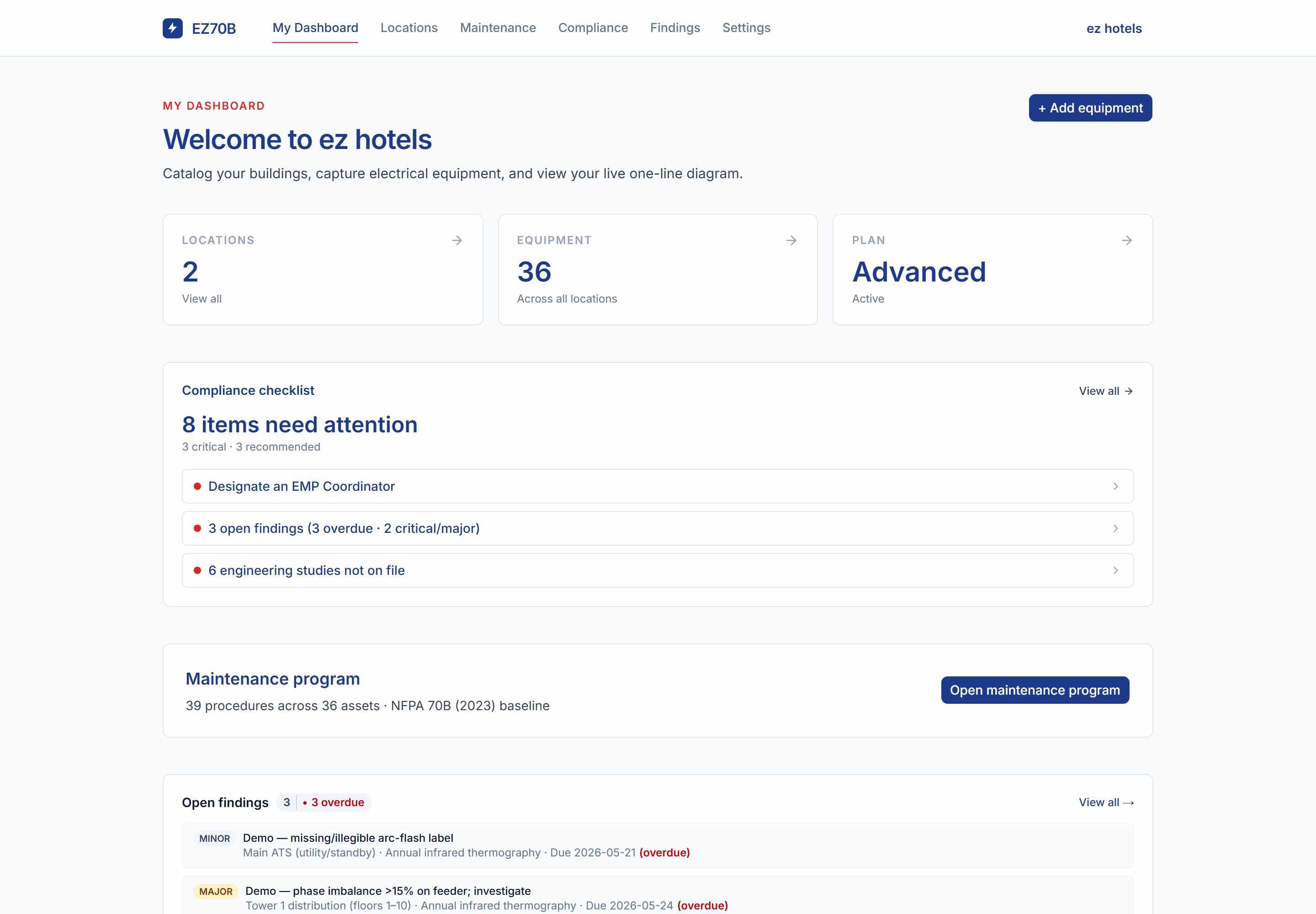
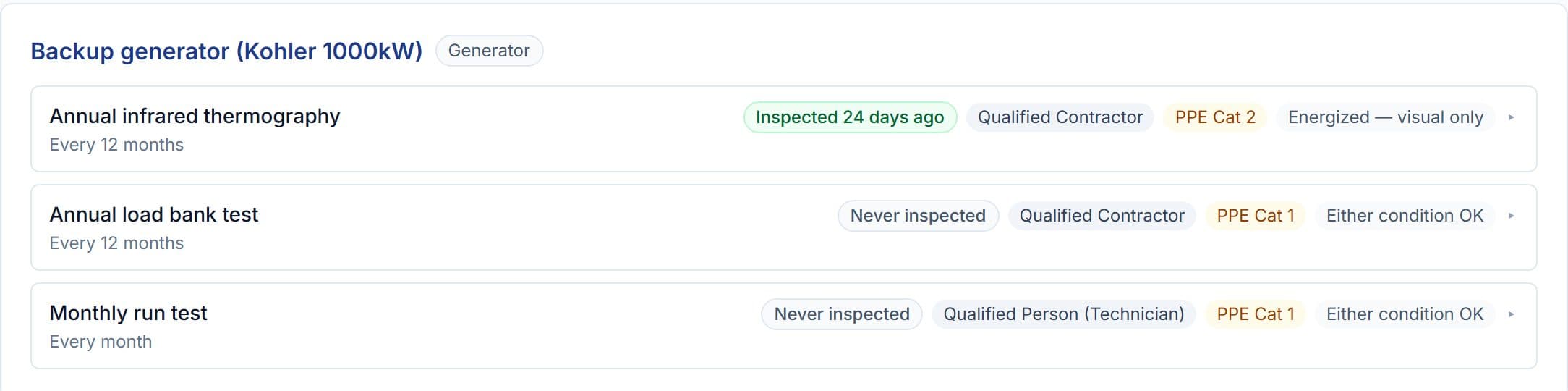
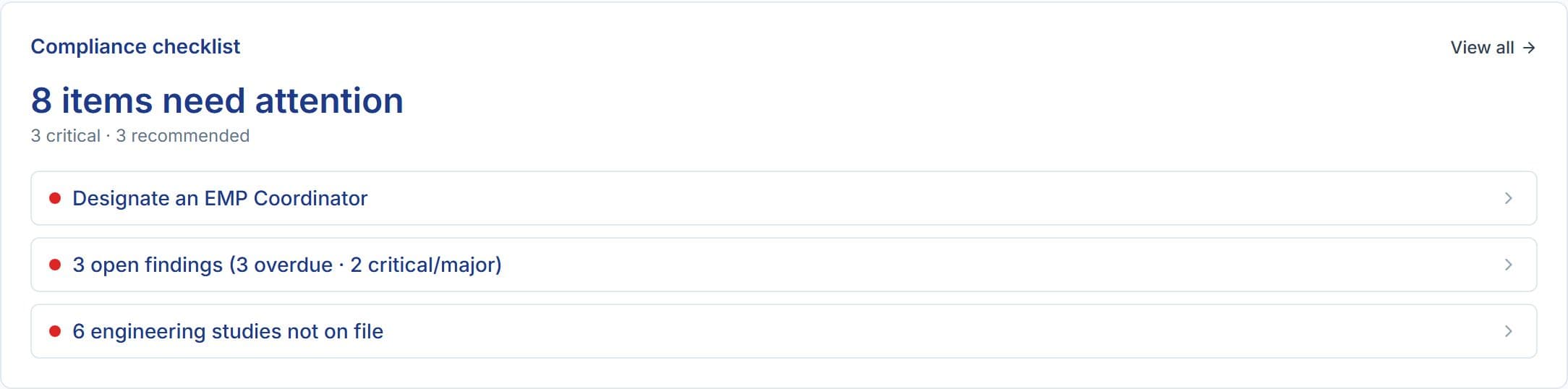
FIG. 1–3 — Dashboard, maintenance program, and the compliance checklist. Real product, real building.
See EZ70B in action — try the live one-line diagram below
Section 02 — From empty account to audit-ready
Three stepsCatalog your equipment
The survey wizard walks any team member through capturing panels, transformers, switchgear — type-aware fields, nameplate photos, no electrical degree required.
The program builds itself
Your one-line diagram generates from the hierarchy. NFPA 70B (2023) maintenance procedures attach to every asset automatically — cadences, PPE categories, citations included.
Operate and accumulate proof
Record inspections in the field, track findings to resolution, and watch the compliance checklist clear itself. Every action lands in the audit log.
- saved for every $1 spent on preventive maintenance vs. reactive repairs
- $4
saved for every $1 spent on preventive maintenance vs. reactive repairs
- fewer equipment breakdowns under a structured PM program
- 70–75%
fewer equipment breakdowns under a structured PM program
- lower maintenance OPEX vs. reactive-only operations
- 12–18%
lower maintenance OPEX vs. reactive-only operations
Reactive repairs are the most expensive way to run a building. The numbers aren't close.
Source: U.S. Department of Energy — FEMP O&M Best Practices Guide, Ch. 5
Section 03 — The one-line diagram
Generated, not drawnGenerated, not drawn — and your inspector can read it.
No spreadsheet and no generic maintenance app can do this: the diagram is a live view of your equipment hierarchy, not a drawing someone has to keep updated.
- One toggle, two audiences. IEEE 315 symbols for the AHJ and your electrician; friendly symbols for the owner. Same data, both correct. Try the toggle →
- Status lives on the diagram. Node colors carry inspection state — green current, amber due soon, red overdue. Walk the building from your desk.
- Vector PDF in one click. Both symbol sets export for the binder — the page the inspector asks for first.
Section 04 — Scope of records
NFPA 70B (2023) · Ch. 4–9NFPA 70B (2023) compliance software with the program built in.
NFPA 70B (2023) doesn't just ask you to maintain equipment — it asks you to prove it, with dated, asset-specific, auditable records. A generic maintenance app is an empty box; EZ70B ships with the cadences, roles, citations, findings, and studies already loaded — and produces each record as your team works.
Equipment inventory
A typed catalog of every asset — by location and equipment class — with multi-parent connections. The backbone the whole program hangs on.
One-line diagram
Generated automatically from your hierarchy, in IEEE 315 or friendly symbols. Export a vector PDF for the binder, the AHJ, or the insurer.
Maintenance procedures
NFPA 70B (2023) inspection cadences keyed to each equipment class, with what is due, due soon, and overdue — live on the program view and your dashboard.
Inspection records
Dated inspection events — who performed them, which procedure steps were completed, and the photos and notes attached to each.
Findings & corrective action
Every issue tracked open → deferred → resolved, with severity mapped to NETA condition so corrective action is documented end to end.
Qualified Person records
Training and certifications per team member, with completion and expiration dates — the EMP Coordinator and Qualified Persons NFPA 70B (2023) requires.
Engineering studies
Short-circuit, coordination, and arc-flash studies tracked per building, with refresh triggers when the system materially changes.
Audit-ready history
An append-only activity log plus a plain-language readiness checklist that tells you, in order, exactly what is left to do.
The EMP binder
Your equipment inventory, inspection history, findings, engineering studies, and Qualified Person roster, assembled on demand into one dated, printable binder — the records an insurer, AHJ, or auditor asks to see.
Section 05 — Qualifications
Phase Tech LLCBuilt by the people who do the work.
EZ70B is built by Phase Tech LLC, a licensed electrical contractor — not a software vendor guessing at the trade. Every maintenance procedure carries its NFPA 70B (2023) chapter citation, so you can trace each cadence to the paragraph it came from. And the product never stamps you “compliant”: it builds the records that let you show your work, which is what an auditor, AHJ, or underwriter actually asks for.
The standards that matter
Installation (NEC)
How electrical systems must be installed. Adopted locally.
Maintenance
How electrical equipment must be maintained. Enforceable.
Worker safety
Electrical safety for people working on the equipment.
Residential inspection
Inspection and testing for existing dwellings, 3+ units.
NFPA 70B became enforceable in 2023. OSHA and most insurers already expect a documented EMP.
If you can't show one when an audit, inspector, or underwriter asks — you don't have one. See what compliance looks like →